

What is thermally modified wood?
Posted: April 27, 2026Author – Ryan Palma Owner/CEO Sustainable Lumber Co.
We are currently developing a new line of thermally modified wood products. Call or email us for more information and pricing, info @ sustainablelumberco.com or (406) 642-7120
What are the pro’s, con’s, and comparisons of Thermally Modified Wood
 Thermally modified wood (also called thermowood or TMW) is regular wood that has been treated with a high heat process, using only heat and steam to permanently alter its chemical and physical properties. No chemicals, preservatives, or additives are involved.
How It’s Made
The process occurs in a specialized kiln or chamber and lasts 24–72 hours. It has three main phases:
- Drying: The wood is gradually heated to remove most of its moisture (down to near zero equilibrium moisture content).
- High heat modification: Temperatures are raised to 180–230°C (about 356–446°F) in a low oxygen or oxygen free environment to prevent burning. This triggers a controlled pyrolysis like reaction.
- Cooling and reconditioning: The wood is cooled, sometimes with added moisture for stability.
This heat breaks down hemicelluloses (sugars and compounds that attract fungi, insects, and decay), partially modifies lignin and cellulose, and reduces the wood’s ability to absorb water. The result is a more hydrophobic (water repelling) material with changed cellular structure.
The process is often compared to “baking” the wood, and it works on both softwoods (i.e., pine, spruce, hemlock) and hardwoods (i.e., ash, oak, poplar).
Key Benefits
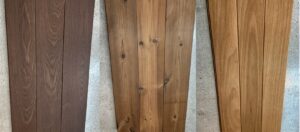 Improved durability and decay resistance: The sugars and nutrients that feed mold, rot, fungi, and insects are largely eliminated or altered, making the wood far more resistant to biological attack than untreated wood.
- Better dimensional stability: It absorbs 40–60% less moisture, so it swells, shrinks, warps, or twists much less in response to humidity or weather changes (often 50–70% reduction in movement).
- Aesthetic change: It turns a rich, uniform chocolate brown or darker tone throughout the entire piece (not just the surface), resembling some tropical hardwoods or cedar. Over time outdoors, it weathers to gray unless coated.
- Eco-friendly: Chemical free, sustainable alternative to pressure treated lumber. It can enhance the performance of fast growing, lower value species.
- Other perks: Better thermal and sound insulation in some cases; reduced resin bleed; suitable for humid environments like saunas.

Drawbacks
- Reduced mechanical strength: It loses some bending strength, toughness, and impact resistance (sometimes 10–30% or more), so it’s generally not recommended for load bearing structural applications like beams or joists.
- Brittleness: Can be more prone to cracking or splitting if not handled carefully (e.g., when fastening near edges, pre-drilling is often advised).
- Higher cost: More expensive than untreated or standard pressure treated wood.
- Color fading: The dark tone weathers to gray in direct sunlight unless protected with finishes.
- Energy intensive process: The high heat requires significant energy, which some critics note as an environmental trade off.
Common Uses
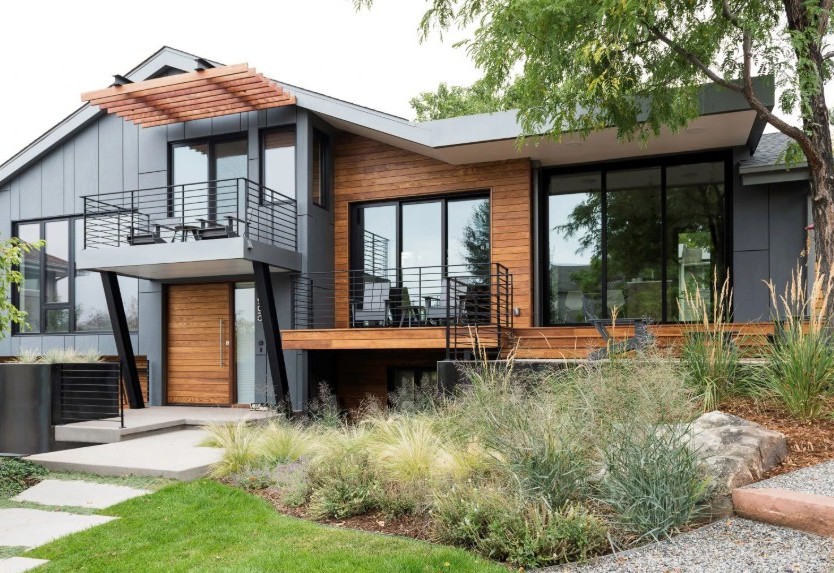 Thermally modified wood excels in non-structural, exterior, or high-moisture applications where stability and appearance matter:
- Decking and outdoor flooring
- Siding, cladding, soffits, and rainscreen facades
- Fencing, pergolas, and trim
- Sauna interiors, spas, or wellness spaces (due to heat/humidity resistance)
- Interior paneling, flooring, ceilings, millwork, and furniture
- Sometimes musical instruments or other specialty items
It performs well in both residential and commercial settings and can be cut, sanded, or worked like regular wood.
How It Compares to Other Options
 Vs. untreated wood: Much more durable, stable, and decay resistant outdoors.
- Vs. pressure treated (chemically preserved) wood: No toxic chemicals (e.g., no copper based preservatives), more stable dimensionally, and often a more natural look/color. However, pressure treated may hold up better in constant ground contact or extreme wet conditions in some cases, and it’s usually cheaper.
- Vs. tropical hardwoods: Offers similar aesthetics and performance without relying on slow growing or imported species, making it more sustainable in many scenarios.
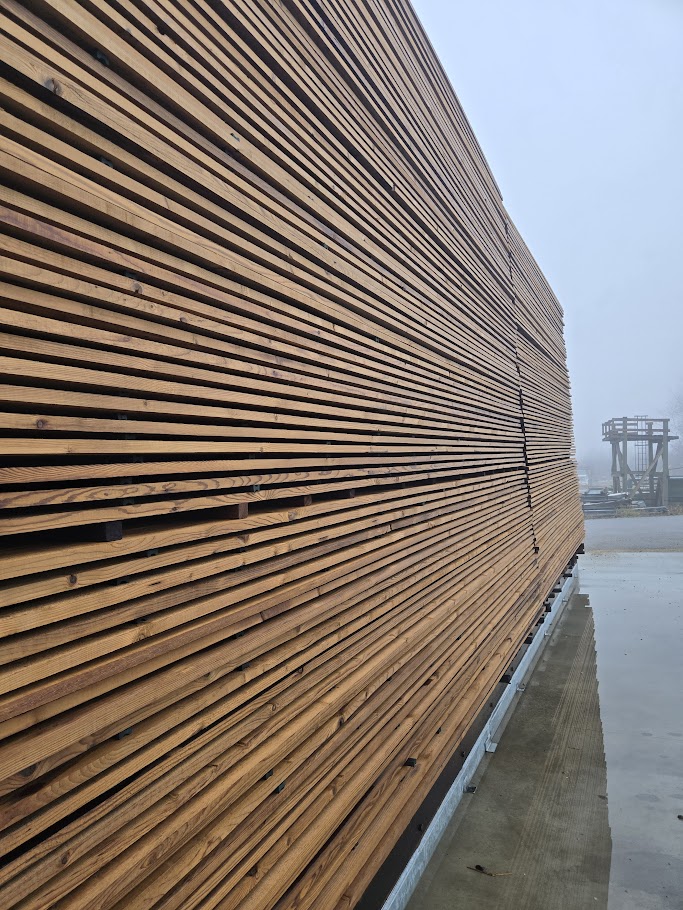
Overall, thermally modified wood is a popular modern choice for architects, builders, and homeowners seeking long lasting, low maintenance, and environmentally conscious wood products, especially for decks, siding, soffits, and outdoor features. Its popularity has grown as an alternative to chemical treatments. If you’re considering it for a project (e.g., in a place like Montana with cold winters and variable humidity), it can be a great fit for non-structural elements.
Contact us for a quote
Our knowledgeable team at sustainable lumber is here to answer any additional questions you may have. Call us today for a free quote (406) 642-7120 or click here to submit an inquiry online. We look forward to helping you with your next project!